
What Are Dental CDT Codes and Why Staying Up to Date Matters
Updated 12/2025
What Are CDT Codes in Dentistry?
In the complex world of dentistry, accuracy and consistency in documentation are essential – not just for patient records, but for the entire financial and administrative ecosystem that supports a dental practice. This is where CDT (Current Dental Terminology) codes come into play.
CDT codes form the foundation of dental billing and insurance reporting. Developed in 1969 and maintained by the American Dental Association (ADA) Council on Dental Benefit Programs’ Code Maintenance Committee, these are a standardized set of procedure codes that define dental services a provider may perform. Updated annually to reflect changes in clinical practice and emerging technologies, CDT codes act as a universal language that connects dentists, insurers, and regulatory systems.
Why CDT Codes Are Critical for Dental Billing and Compliance
More than just billing tools, CDT codes are the HIPAA-mandated standard for documenting and reporting dental services delivered to patients. Their role extends far beyond reimbursement- they underpin key operational functions like accurate patient documentation, claims processing, revenue management, and even large-scale data analytics that help track oral health trends across the industry.
In short, reporting CDT codes correctly doesn’t just reduce claim denials and maximize reimbursement – it ensures that every treatment, from a routine cleaning to complex restorative procedures, is recorded and communicated with precision, consistency, and compliance.
Why Are Recent Changes to Dental CDT Codes Important?
Dentistry evolves rapidly, with new materials, digital tools, and procedures emerging each year. Updated CDT codes allow these innovations to be properly identified, coded, and potentially reimbursed by insurance depending on plan-specific policies. Without timely code updates, new treatments might not be recognized by insurance carriers or thoroughly documented in the patient’s chart, creating barriers to patient access, provider adoption, and accurate clinical records.
How CDT Code Updates Affect Claims, Reimbursement, and Compliance
In addition, accurate billing relies on precise procedure codes. When CDT codes are revised, added, or deleted, it helps eliminate ambiguity and ensures both providers and payors interpret services consistently. This reduces claim denials, improves reimbursement rates, and streamlines the revenue cycle for dental practices.
Since CDT codes are the HIPAA-designated standard for electronic claims and dental service documentation, staying up to date is not optional. Using outdated codes can lead to compliance issues, rejected/denied/delayed claims, or even legal complications.
Furthermore, every CDT code used contributes to broader data on dental trends – such as preventive care utilization, restorative treatment patterns, and access to emerging therapies. By keeping these codes current, public health researchers and policymakers gain accurate data that informs better oral health strategies nationwide.
Where Do I Find the Most Recent CDT Code Changes?
The American Dental Association publishes the CDT Code annually. If you’re just looking for CDT codes, nomenclatures, and descriptors, their book can help you. Practice Booster’s Dental Coding With Confidence and online Code Advisor expand on the CDT Code with predictive error correction based on the clinical protocols, code reporting, clinical procedure counts, and fee analyses of thousands of dental practices across the country.
While the CDT Code was designed to establish standardized codes and descriptions to report dental procedures, guidance as to the specific application of many of these codes is limited. In particular, no ADA publication is designed to identify and correct common coding errors. Practice Booster provides that “missing link,” with guidance and strategies for proper application and reporting of the most recent code set, while greatly reducing errors, optimizing legitimate reimbursement, and helping practices stay in compliance.
Benefits of Practice Booster’s Dental Coding With Confidence and Code Advisor
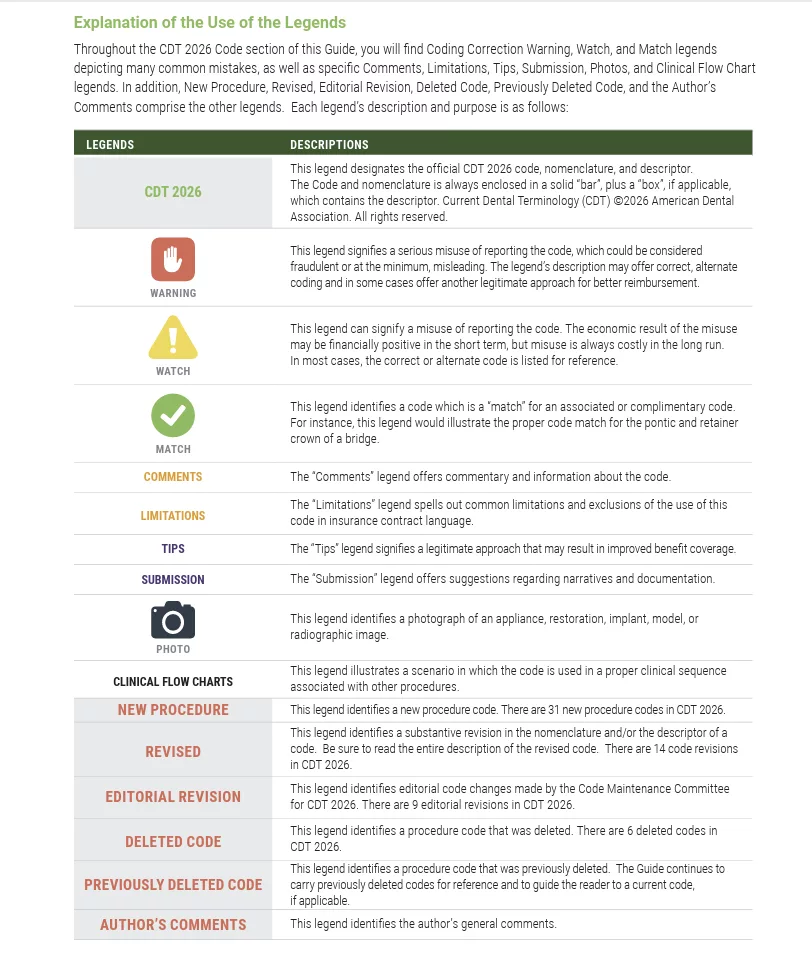
Dental Coding With Confidence offers:
- Extensive information regarding the proper submission of CDT codes and supporting documentation to dental payors to minimize delays and denials
- Advice and strategies to prevent coding errors, encourage proper reporting, and streamline clinical protocols using Predictive Error Correction
- Supplemental information to the additions, revisions, and deletions made to the CDT Code each year
- Guidance on common insurance plan requirements, exclusions, limitations, and reimbursement expectations.
Watch the video by clicking here to learn about the additional perks of a Code Advisor subscription!
Do I Need Dental Coding With Confidence for My Practice?
Giving your in-house billing team the tools of the trade for accurate claim submission is essential. Spending time chasing down an unpaid claim means time spent away from patients, an increase in A/R, and less money in the bank. Dental Coding With Confidence literally gives your team the confidence they need to be able to accurately and swiftly manage claims, without worrying about whether or not they’ll be denied due to coding errors.
Outsourcing Dental Billing and Coding to a Trusted Partner
If you’re looking to completely outsource your billing department, eAssist Dental Solutions integrates fully with Practice Booster’s coding resources to give your practice the peace of mind it deserves. No longer will your team have to worry about missing or inaccurate coding or narrative structure. Plus, your insurance AR is diligently worked to bring it near to zero (and keep it there). The investment in your practice means future scalability and profits to share with your team. Take the burden of dental billing off your office, and achieve peace of mind today.
Disclaimer: Insurance administration and dental billing recommendations presented here represent the opinions of the author or our staff and are for informational purposes only. You are responsible for your own use of the CDT Codes, insurance administration, and dental billing. For the latest CDT codes and official interpretations, contact the American Dental Association or visit ADA.org.
Spotlight
The 7 Deadly Sins of Dental Claims Denials
Learn how to avoid the most common claim mistakes and get paid faster.
Download eBook

Dental Insurance Billing Done for You
Discover how eAssist helps practices simplify billing and boost collections.
See How It Works

Talk to a Dental Billing Specialist
Not sure where to start with medical billing? Let’s talk.
Book a Consultation