CEO & Co-Founder, eAssist
Dr. James Anderson is a practicing dentist and the CEO and Co-Founder of eAssist Dental Solutions, the nation’s leading platform for dental billing. A serial entrepreneur, Dr. Anderson has built multiple successful ventures, including eAssist and nine dental practices in Utah, all driven by his mission to help dentists, their teams, and their patients achieve peace of mind. He co-founded eAssist in 2011 to give dental practice owners the ability to fully outsource their billing departments—a vision that now serves over 2,400 practices nationwide. Under his leadership, the company has formed strategic partnerships with the California Dental Association and Henry Schein, and earned a spot on the Inc. 5000 list for nine consecutive years. In 2020, Dr. Anderson was recognized as Entrepreneur of the Year by Business View Magazine and ranked among the top entrepreneurs in the country by Entrepreneur Magazine. He holds a B.S. in Finance from Brigham Young University, a D.M.D. from Oregon Health & Science University, and completed the three-year O.P.M. program at Harvard Business School. He also serves as Chairman of the Dental MBA Advisory Board at Roseman Dental School.
D4341 & D4342: A Common Coding Error
Updated 12/2025
Dental coding is ever-evolving. In fact, with 60 additional CDT code updates in the 2026 Code set, it’s no surprise that a common reason for dental denials is incorrect coding.
One of the most common—and most preventable—reasons for costly denials comes down to two codes that look nearly identical:
If you’ve ever felt that frustrating gut-punch after a denial lands in your inbox—especially for scaling and root planing (SRP)—you’re not alone. The smallest oversight can stall cash flow, delay patient care, and create tension in an already overloaded dental team.
D4341 vs D4342: The Difference That Changes Everything
On the surface, these two codes differ by a single detail: the number of teeth treated.
- D4341: Scaling and root planing, 4+ teeth per quadrant
- D4342: Scaling and root planing, 1–3 teeth per quadrant
That’s it—one number.
And because these codes sit at the center of periodontal billing, getting them wrong can lead to accusations your office never wants to see in writing—like upcoding or insufficient documentation.
The Hidden Triggers Behind SRP Denials
Opinions within the dental community vary regarding the precise threshold for measurements as a clinical indicator for SRP. As such, each payor sets its own standards based on available evidence, internal expertise, and employer-specific considerations. These criteria can vary significantly—not only between payors but sometimes even among different plans with the same payor.
That said, clinical requirements for SRP to be considered for reimbursement generally include:
- Minimum of 4-5mm pocket depth
- 2 mm of Clinical Attachment Loss (CAL) – indicated on bitewing radiographs
- Bleeding on probing – indicated on periodontal chart
Common Documentation Requirements for SRP Claims
Documentation requirements typically include:
- Six-point periodontal pocket depth charting performed within 12 months of treatment that includes documentation of:
- clinical attachment loss
- tooth mobility
- bleeding on probing
- furcation involvement
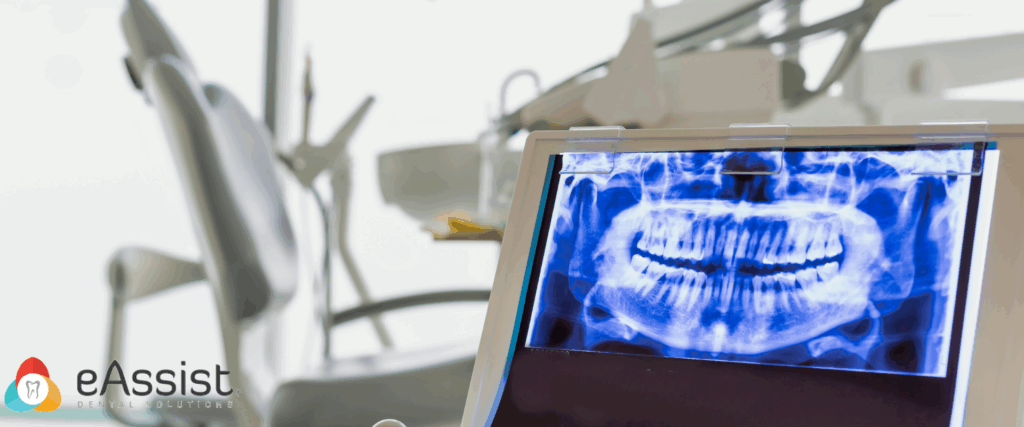
- Preoperative, diagnostic-quality, full-mouth radiographs showing bone loss – this could be an FMX (D0210) or a Pano (D0330), including bitewings (D0274)
- Narrative/clinical notes documenting:
- Staging and grading of the periodontal diagnosis
- Periodontal prognosis and treatment plan
- Risk factors for the occurrence and progression of periodontitis (i.e., poor oral hygiene, irregular root anatomy, adverse habits (e.g., smoking), and systemic conditions (e.g., diabetes, immunodeficiency conditions)), if applicable
- Start and stop treatment times
- Anesthetic used and dosage
It’s important to review payor-specific guidelines before submitting SRP claims to insurance. Many payors list these on their website (typically behind member or provider log-in), in provider reference manuals, or upon request.

Another Denial Because You Treated “Too Much” in One Visit?
Some patients may benefit from completing all four quadrants of SRP on the same day. Examples include:
- If a patient needs to be sedated
- If the patient has to travel extensively to complete treatment
- For Medical reasons, like needing to be premedicated or coming off of a medication (blood thinners)
Completing all four quadrants on the same day typically requires pre-approval to avoid treatment being disallowed (i.e., insurance doesn’t pay and you can’t bill the patient).
How D4341 and D4342 Go Wrong—Fast
The conditions listed below are commonly viewed as factors that make scaling and root planing inappropriate, unwarranted, clinically substandard, insufficiently supported by documentation, or incomplete:
- Gingivitis without attachment and bone loss
- Supragingival and subgingival calculus without attachment loss
- SRP as definitive treatment for severe/advanced stage periodontitis
- Teeth with hopeless periodontal, endodontic, or structural prognosis
- Amount of time spent performing SRP was inadequate for the number and condition of treated teeth
- Anesthetic not documented, indicating it was not used and falls below the standard of care
- SRP of treated teeth was incomplete and inadequate for the control of periodontitis
- SRP failed to include teeth requiring treatment due to periodontitis
- Inadequate or incorrect documentation of SRP
Even appointment duration matters now. Payors want verification that the time spent matches the intensity of SRP to prevent fraud, waste, and abuse.
This is the new reality of dental billing.
Two Codes. One Big Problem. One Simple Solution.
D4341 and D4342 continue to be a significant source of lost revenue and administrative fatigue for practices nationwide. Your job is caring for patients. At eAssist, our job is to deliver peace of mind by helping you collect what is rightfully owed to you. If you want fewer headaches, fewer denials, and more money coming in, we’re here to help. To learn more, schedule a complimentary consultation.
Disclaimer: Insurance administration and dental billing recommendations presented here represent the opinions of the author or our staff and are for informational purposes only. You are responsible for your own use of the CDT Codes, insurance administration, and dental billing. For the latest CDT codes and official interpretations, contact the American Dental Association or visit ADA.org.
Spotlight
The 7 Deadly Sins of Dental Claims Denials
Learn how to avoid the most common claim mistakes and get paid faster.
Download eBook

Dental Insurance Billing Done for You
Discover how eAssist helps practices simplify billing and boost collections.
See How It Works

Talk to a Dental Billing Specialist
Not sure where to start with medical billing? Let’s talk.
Book a Consultation