
Common Dental Coding Complexities That Impact Practice Revenue
Updated 12/16/25
Navigating dental codes can feel like an obstacle course with twists, turns, and hurdles. However, mastering dental coding is essential for accurate documentation and keeping your practice’s finances on track. Effective coding helps you avoid costly setbacks and keeps your revenue cycle running smoothly. Let’s break down the essentials so you can optimize your dental billing and coding and focus on what matters most – patient care.
What Is Dental Coding?
Dental coding is the process of translating clinical procedures into standardized codes that are recognized across the industry. These codes are the official terminology used to define dental procedures in the patient record under HIPAA. Using the correct CDT codes helps maximize legitimate reimbursement and avoid misunderstandings with insurance payors. While CDT codes are used for communication with insurers, their primary use is to document services provided accurately.
Why Do Dental Codes Matter?
Dental codes are the backbone of a smooth revenue cycle. Coding errors can lead to delayed payments, claim denials, and financial setbacks that hurt your practice’s cash flow. Think of dental coding as a language. If we aren’t using the same language as the insurance company, communication falls apart. Coding correctly helps streamline claims processing by minimizing payment delays and maximizing legitimate reimbursement.
By staying up to date with current CDT codes and applying them correctly, you not only mitigate compliance risk but also aid in securing timely and accurate payments critical for maintaining the financial health of your practice.
What Are CDT Codes?
Maintained by the American Dental Association (ADA), Current Dental Terminology (CDT) codes are essential for documenting procedures and for precise communication with others involved in a patient’s care, including claims submission and insurance reimbursement. Organized into 13 categories of service, CDT codes cover a broad range of dental procedures, from diagnostics to sleep apnea services.
Each CDT code consists of a 5-character alphanumeric sequence beginning with the letter “D,” followed by nomenclature and often a procedure descriptor. A code’s nomenclature is the written, literal definition of a procedure code. Many, but not all, CDT codes include a descriptor – a written narrative that provides additional information and describes the procedure’s clinical aspects.

DXXX Nomenclature
Descriptor
The 13 Categories of Service in the CDT Code
The ADA categorizes CDT codes into 13 distinct service categories, each addressing a different area of dental care. Familiarity with these categories helps ensure accurate billing and fewer claim issues.
Diagnostic
Codes for diagnostic procedures, from evaluations to radiographs, form the foundation for accurate treatment planning.
Preventive
Preventive codes cover services such as cleanings and fluoride treatments aimed at maintaining oral health.
Restorative
Restorative codes apply to fillings, crowns, and other repairs for decayed or damaged teeth.
Endodontics
Endodontic codes are used for root canals and procedures addressing tooth pulp issues.
Periodontics
Codes for periodontal treatments include scaling and root planing, and surgical interventions for gum health.
Prosthodontics, Removable
These codes include dentures and partials, providing solutions for patients needing removable replacements for missing teeth.
Maxillofacial Prosthodontics
Codes here cover prosthetics for maxillofacial areas, aiding in facial structure rehabilitation.
Implant Services
Implant codes apply to placing and restoring dental implants, offering permanent solutions for missing teeth.
Prosthodontics, Fixed
Fixed prosthodontic codes cover permanently affixed restorations like bridges and implant/abutment supported prostheses.
Oral & Maxillofacial Surgery
Surgical codes include extractions, biopsies, and other surgical procedures for treating jaw and mouth conditions.
Orthodontics
Orthodontic codes cover braces, clear aligner therapy, and corrective procedures for teeth and jaw alignment.
Adjunctive General Services
These codes cover miscellaneous services, from anesthesia to office visits, supporting comprehensive care.
Sleep Apnea Services
This category, new as of 2025, includes codes for fabricating and adjusting appliances for the treatment of sleep apnea.
Common CDT Codes in Dentistry
CDT codes are the foundation of dental billing, covering preventive to restorative care.
| Frequently used CDT codes include: | ||||||
|---|---|---|---|---|---|---|
| D0120 | D0150 | D0180 | D0210 | D1110 | D1120 | D1206 |
| D1208 | D2740 | D4341 | D4342 | D7140 | D7210 | D9110 |
Common Coding Errors:
- D0210 can be a common coding error when mixed up with D0220 and D0230.
- D1110 is a common coding error when mixed up with D1120.
- D4341 can be a common coding error when mixed up with D4342.
- D7210 can be a common coding error when mixed up with D7140.
- D9110 can be a common coding error when used instead of D0140.
Since 2020, over 300 changes have been made to CDT codes, underscoring the importance of regular reviews to stay up to date and optimize reimbursements.
Best Practices for Accurate Dental Codes
Using accurate dental codes and proper documentation is extremely important because, without proof of medical necessity, a claim may be denied.
Achieving accuracy in billing and maximizing reimbursements starts with these best practices:
- Use reliable resources: Trusted resources like Practice Booster’s Dental Coding with Confidence or online Code Advisor are invaluable, providing comprehensive, user-friendly guidance with regular dental code updates, error prevention, and insights.
- Avoid common dental coding errors: Selecting the wrong dental code can delay or reduce payment. For instance, D0140 (limited oral evaluation) should not be used for every emergency if D9110 (palliative care) or D3221 (pulpal debridement) better describes the service to avoid the evaluation frequency limitation.
- Avoid combining multiple procedures or services under one code: While some CDT codes are intentionally “inclusive,” many diagnostic services are billable separately and should not be bundled.
- Submit thorough documentation: Documentation like clinical notes, radiographs, and intraoral images supports coding, speeding up reimbursements, and minimizing denials. For guidance on proper documentation practices, Practice Booster’s Dental Documentation with Confidence publication can help.

Dental Coding Pain Points That Are Draining Your Revenue (And How to Fix Them!)
If your practice is struggling with dental coding, you’re not alone. Here are some common pain points—and solutions–to keep your practice running smoothly:
- Frequent coding errors: Small mistakes add up, leading to revenue losses and rejected claims.
Solution: Keep dental billing and coding resources updated to avoid costly errors. - Documentation mismatches: When documentation doesn’t align with the codes, denials follow.
Solution: Standardize documentation practices for consistency. - Insurance verification issues: Insurance details change often. Missed or incomplete verifications can lead to claim delays and rejections.
Solution: Automate insurance verification to prevent errors and delays. - Inefficient workflows: Manually managing claims and payments wastes time and can lead to errors.
Solution: Automate tasks like claim submissions and payment postings to streamline workflow. - Lack of regular training: Coding guidelines evolve, and without training, teams may miss updates that affect revenue.
Solution: Invest in regular team training to stay current with code changes and documentation requirements.

Simplify Your Practice Revenue Cycle By Outsourcing Your Dental Billing and Coding
Coding problems can be complex, creating bottlenecks that affect revenue and frustrate your team. If you don’t have time to invest in ongoing training, maintain thorough documentation, or stay up to date on code changes, consider outsourcing your dental billing and coding with eAssist. Taking the process out of the office can free up your team’s time, streamline your revenue cycle, and enhance your financial stability. To learn more, schedule a consultation today.
Spotlight
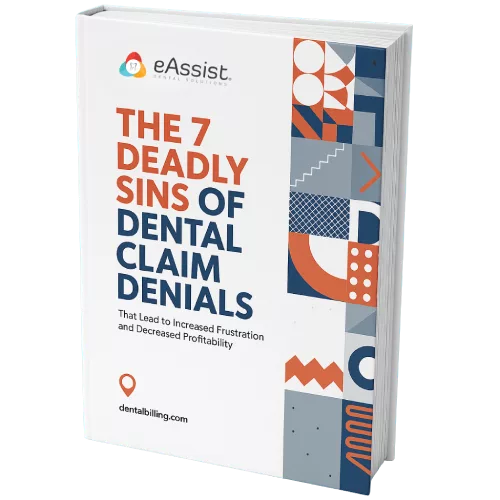
The 7 Deadly Sins of Dental Claims Denials
Learn how to avoid the most common claim mistakes and get paid faster.
Download eBook

Dental Insurance Billing Done for You
Discover how eAssist helps practices simplify billing and boost collections.
See How It Works

Talk to a Dental Billing Specialist
Not sure where to start with medical billing? Let’s talk.
Book a Consultation