
Co-Founder and CXO, eAssist
Sandy Odle is the Co-Founder and CXO of eAssist Dental Solutions, where she has played a key role in shaping the company’s business and marketing strategies, leading to record growth and national recognition on the Inc. 500 and Utah Top 100 lists. A passionate social entrepreneur, Sandy believes that business is about building meaningful connections and creating personalized solutions that truly meet customer needs. Her relentless commitment to delivering exceptional client experiences is at the heart of eAssist’s mission. Drawing on the discipline and attention to detail honed during her early career as a ballet dancer, Sandy brings a unique blend of creativity, precision, and work ethic to everything she does.
D6058 vs D6065: Implant and Abutment Supported Crowns
Updated 12/28/25
Should I use code D6058 or D6065 for implant crowns? When is it appropriate to report the abutment separately?
Billing D6058 vs D6065
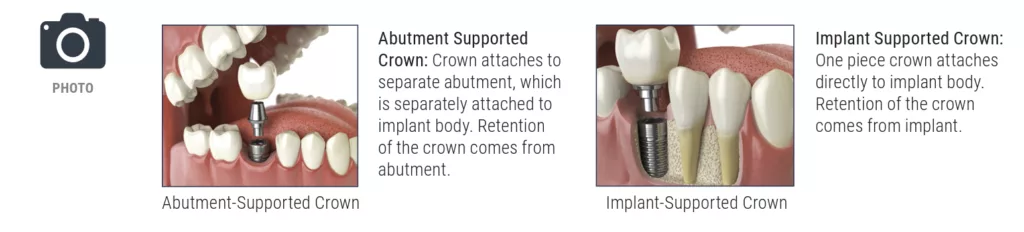
Do not report abutment supported crowns as implant supported crowns or vice versa. Both abutment supported and implant supported crowns may be cemented or screwed to the supporting structure, but neither of these options is a determining factor in code selection. The determining factor on what to call the restoration and how to code it is determined by whether the abutment is or could be attached independently to the implant body, and from where the permanent crown gets its retention.
Abutment Supported Crowns
Abutment supported crowns are attached to and obtain stability from an intermediary abutment, which is SEPARATELY attached to the implant body. The abutment can be attached without the crown. Additionally, the retention of the crown comes only from its attachment to the abutment, and it is not secured to the implant body directly. Ultimately, this system uses two independent pieces, which are each coded separately.
Usually, these two pieces are each placed in the mouth individually, with the abutment being torqued into place first and the crown being seated as a separate step. The exception to this comes with what is known as a “screwmentable” crown, where the components COULD be placed individually, but the crown is manufactured with an access hole through the occlusal. This allows for the torquing of the abutment screw after extra oral cementation. This is a hybrid of the two types of restorations and is still considered abutment supported since the crown is only retained by cementation to the abutment, not by the screw itself, and the abutment COULD have been placed independently.
Implant Supported Crowns
Alternatively, implant supported crowns attach DIRECTLY to and gain support from the implant body. The retention of the crown itself comes from attachment directly to the implant, not just to the abutment. The entire unit is placed and torqued to the implant body in one step. Even though a fabrication “abutment” may be used in the manufacturing process, it is delivered as an integral part of the one-piece implant supported crown. This “abutment” could not be placed as an individual step on its own and stand independently without the crown. As such, the whole assembled unit is considered an implant supported crown, and the abutment cannot be reported as a separate procedure.
Coding Application and Fee Considerations
Source: (2025). General Comments for Implant Services [Photograph]. Dental Coding With Confidence 2026. Page 291.
With the first system (abutment supported), you will code for a prefabricated abutment (D6056) or custom abutment (D6057), plus the crown itself. Use the proper code for the correct crown material. For an abutment supported single porcelain ceramic crown, report D6058.
For the second system (implant supported), there is no separate abutment reported. The single implant supported porcelain ceramic crown is coded as D6065. The fee for an implant supported crown should be set higher (roughly equal to the fee for an abutment plus an abutment supported crown) to offset the increased lab bill and inability to report a separate abutment.
Common Coding Errors
Coding for implant/abutment supported restorations and prostheses are commonly misreported due to all the nuances involved and CDT codes available to choose from. Prevent coding errors today with additional tips from the Coding Advisors at Practice in their Dental Coding With Confidence or their online Code Advisor!
CDT Coding Support
If you are struggling with CDT coding, consider partnering with eAssist. Our Success Consultants have full access to the entire Practice Booster library to support you in coding for what you actually do as documented in the patient’s clinical record. To find out more, schedule a free consultationhere.
Disclaimer: Insurance administration and dental billing recommendations presented here represent the opinions of the author or our staff and are for informational purposes only. You are responsible for your own use of the CDT Codes, insurance administration, and dental billing. For the latest CDT codes and official interpretations, contact the American Dental Association or visit ADA.org.
Spotlight
The 7 Deadly Sins of Dental Claims Denials
Learn how to avoid the most common claim mistakes and get paid faster.
Download eBook

Dental Insurance Billing Done for You
Discover how eAssist helps practices simplify billing and boost collections.
See How It Works

Talk to a Dental Billing Specialist
Not sure where to start with medical billing? Let’s talk.
Book a Consultation