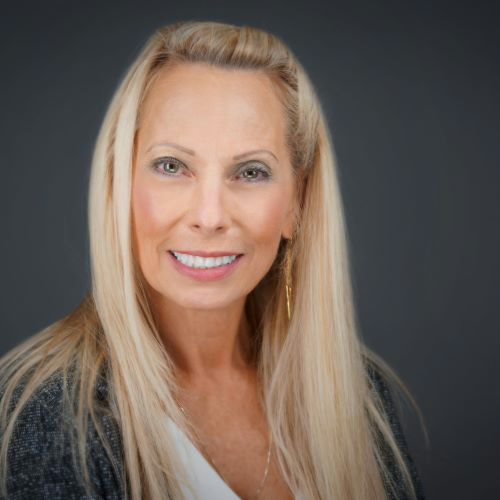
Co-Founder and CXO, eAssist
Sandy Odle is the Co-Founder and CXO of eAssist Dental Solutions, where she has played a key role in shaping the company’s business and marketing strategies, leading to record growth and national recognition on the Inc. 500 and Utah Top 100 lists. A passionate social entrepreneur, Sandy believes that business is about building meaningful connections and creating personalized solutions that truly meet customer needs. Her relentless commitment to delivering exceptional client experiences is at the heart of eAssist’s mission. Drawing on the discipline and attention to detail honed during her early career as a ballet dancer, Sandy brings a unique blend of creativity, precision, and work ethic to everything she does.
CDT Code D2980: Crown Repair Billing Guidelines
Updated 12/26/25
D2980 is a “crown” repair to a ¾ crown or full crown. It is to repair a material failure(fracture) on any part of the crown.
Billing CDT Code D2980
Decay Below the Crown Margin
If a filling is needed to repair decay below the crown’s margins, report the appropriate amalgam or composite code, including a narrative such as:
“A facial composite was placed below the margin of the crown in the area of facial decay.”
Endodontic Access Closure Through an Existing Crown
For endodontic access closure (through an existing cemented or bonded posterior crown), consider a single surface amalgam (D2140) or composite (D2391) with a narrative to report this type of service if the crown is intact.
These procedures are typically reimbursed at 80% of the payor’s fee.
However, a few payors could require that D2980 be reported for closure of an intentional endodontic access opening made through an existing crown, but this would be rare.
D2980 was revised to emphasize it is restricted to a materials failure, and opening for the endodontic access is not a material failure.
Do Not Report D2980
Core Build-Ups Without Crown Removal
Do not report D2980 in conjunction with D2950 when the crown has not been removed to place the core buildup.
A core buildup is for retention of the crown and should not be reported if the crown remains in place.
Implant-Supported or Bridge Restorations
Do not report D2980 for crown repair of an implant supported restoration or a fixed partial denture (bridge).
See D6090 and D6980, respectively.
Inlays, Onlays, and Veneers
Do not report D2980 for the repair of an inlay, onlay, or veneer.
See D2981, D2982, and D2983, respectively.
Frequency Limitations and Reimbursement Considerations
A crown repair (D2980) may be subject to the five to 10 year limitation for a replacement crown, and if performed, may limit the replacement of that crown by the same term.
If reimbursed, the amount may be 50% of the payor’s fee.
D2980 may not be billable to the patient for the first 12-24 months after initial placement, depending on plan processing criteria.
Documentation Requirements
Accompanying clinical documentation should describe the crown repair procedure.
The fee reimbursed may be based on the time necessary to perform the service and amount of the laboratory bill, if applicable.
It is suggested that the time spent be included in the documentation, and a copy of the laboratory bill be attached.
Additional Coding Resources and Support
Additional tips regarding proper reporting for restoration repairs can be found in Practice Booster’s Dental Coding With Confidence or their online Code Advisor!
If you are struggling with CDT coding, consider partnering with eAssist. Our Success Consultants have full access to the entire Practice Booster library to support you in coding for what you actually do as documented in the patient’s clinical record. To find out more, schedule a free consultation here.
Disclaimer: Insurance administration and dental billing recommendations presented here represent the opinions of the author or our staff and are for informational purposes only. You are responsible for your own use of the CDT Codes, insurance administration, and dental billing. For the latest CDT codes and official interpretations, contact the American Dental Association or visit ADA.org.
Spotlight
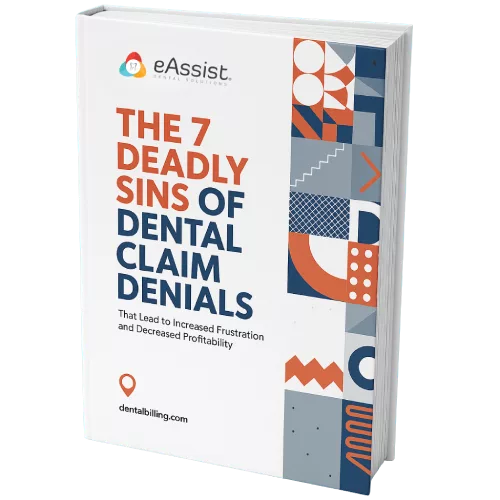
The 7 Deadly Sins of Dental Claims Denials
Learn how to avoid the most common claim mistakes and get paid faster.
Download eBook

Dental Insurance Billing Done for You
Discover how eAssist helps practices simplify billing and boost collections.
See How It Works

Talk to a Dental Billing Specialist
Not sure where to start with medical billing? Let’s talk.
Book a Consultation